Story · sound recordings, subtitles · captured 1 November 2026 (UTC)
Sounds of the past
A recitation of the Gettysburg Address on a Berliner gramophone disc of 1898, the transcript the Archive's speech recognition made of it, and Lincoln's text as printed in 1864, compared word by word.
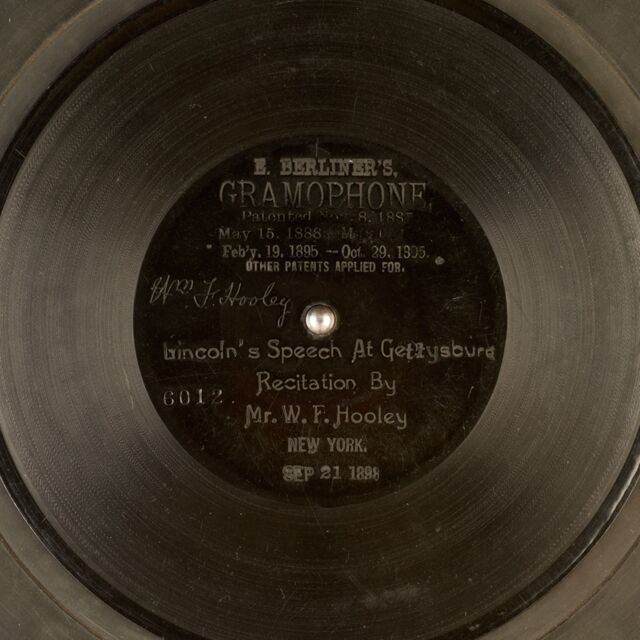
Lincoln's Speech At Gettysburg. E. Berliner's Gramophone, catalogue no. 6012.get_page_image · 78_lincolns-speech-at-gettysburg_mr-w-f-hooley_gbia0362658a.jpg
the run
The question
captured 1 November 2026 (UTC) · scripts/site/capture.py
asked
Is there an old recording of the Gettysburg Address? Let me hear it, and check its transcript against Lincoln's words as they were printed at the time.
The assistant counted how many old recordings carry subtitle files, found the record by title, read its metadata and its subtitle files, then found Lincoln's text in an 1864 printing and read that page. Each section below names the tools that made it; all 10 calls, in order, with what each returned, are in the receipts at the end.
audio items dated 1890–1945 on archive.org have a SubRip subtitle file (as of 1 November 2026 (UTC))
1898-10-21
the record's date in its metadata
6012
catalogue number, E. Berliner's Gramophone
Lincoln's Speech At Gettysburg, a recitation by Mr. W. F. Hooley, digitised from a disc in fair condition. The recording on the other side of this disc: Not completed due to physical condition of disc. Technical Notes: Acoustic
The label in the photograph above appears to read “SEP 21 1898”; the item's date field says 1898-10-21. We read the label from the image; the tool returned only the date field.
The item has 2 subtitle files (WebVTT, SubRip), both marked machine-made: made by speech recognition, not typed by a person. Read as timed text, the cues run from 00:00:01 to 00:01:47. Words that differ from the 1864 printing are underlined, on both sides: 36 differences in all. Point at one, or tab to it, to see its counterpart on the other side. Press a cue's time to hear it from there; the record streams from archive.org.
203 of 265
words of the printed address appear, in order, in the machine's transcript
[...] at Pittsburgh by Mr. William S. Dooley. Oh, sure, and seven years ago, our fathers brought forth on this continent a new nation, conceived in liberty and dedicated to the proposition that all
men are created equal. Now we are engaged in a great civil war, a single part of that nation, or any nation so complete and dedicated and long-ensured, can live through such a struggle. We are met on a trace that of the use of that war.
We are met to dedicate a portion of it as a final resting place of all who gave their lives that that nation might live. We destroyed together fitting and proper that we should do this. But in a larger sense, we cannot dedicate, we cannot concentrate,
we cannot follow this ground. The brave men living and dead who have struggled here have consecrated power above all power to act or to interact. The world will very little note or long remember what we say here, but it can
never forget what they did here. It is for us the living, better to be dedicating the unfairness worth that they don't normally carry on. It is for us better to be real dedicated to the great fact remaining before us
that from these honest days we take increased devotion. That we hear highly resolved that these days shall not have died in vain, that the nation shall under God have a new birth of freedom. And the government of the people, by the people, or the people, shall not
perish from the earth.
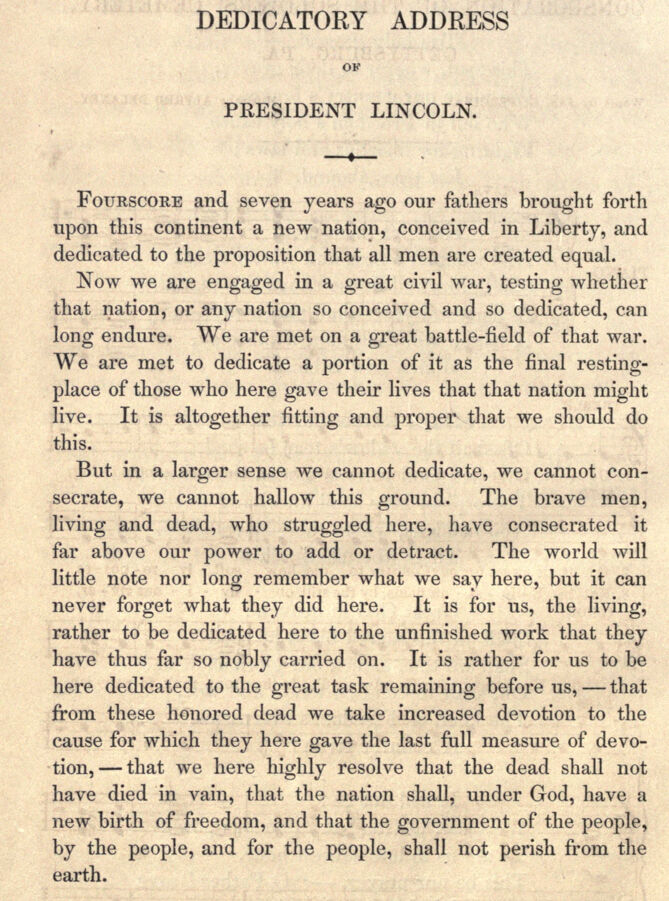
FOURSCORE and seven years ago our fathers brought forth upon this continent a new nation, conceived in Liberty, and dedicated to the proposition that all men are created equal.
Now we are engaged in a great civil war, testing whether that nation, or any nation so conceived and so dedicated, can long endure. We are met on a great battle-field of that war. We are met to dedicate a portion of it as the final resting-place of those who here gave their lives that that nation might live. It is altogether fitting and proper that we should do this.
But in a larger sense we cannot dedicate, we cannot consecrate, we cannot hallow this ground. The brave men, living and dead, who struggled here, have consecrated it far above our power to add or detract. The world will little note nor long remember what we say here, but it can never forget what they did here. It is for us, the living, rather to be dedicated here to the unfinished work that they have thus far so nobly carried on. It is rather for us to be here dedicated to the great task remaining before us, — that from these honored dead we take increased devotion to the cause for which they here gave the last full measure of devotion,— that we here highly resolve that the dead shall not have died in vain, that the nation shall, under God, have a new birth of freedom, and that the government of the people, by the people, and for the people, shall not perish from the earth.
Words heard in each cue, as printed or not
Orange: words that match the 1864 printing in order; grey: words that differ. Point at a bar for its numbers.
as printed
different
Show as a table
Cue
Words as printed
Different
00:00:01
23
10
00:00:20
30
17
00:00:37
41
6
00:00:55
33
9
00:01:11
31
10
00:01:26
42
7
00:01:47
4
0
The first cue looks like the record's spoken announcement, heard as “at Pittsburgh by Mr. William S. Dooley”, where the label and title say Gettysburg and Mr. W. F. Hooley; and “Oh, sure, and seven years ago” looks like a mishearing of “Fourscore and seven years ago”. A difference can be the machine's or the reciter's own wording: only listening tells which, and we haven't judged that here.
“Dedicatory Address of President Lincoln”, printed page 84, in Address of Hon. Edward Everett, at the consecration of the National cemetery at Gettysburg, 19th November, 1863 : with t…scan page 94 · archive.org/details/addofhonedev00everrich
Published by Boston : Little, Brown in 1864: the address Edward Everett gave at the consecration of the cemetery at Gettysburg, “with the dedicatory speech of President Lincoln”, as the title says. Searching inside it for “Fourscore” found 1 match, on scan page 94; that page's OCR text is the printed side of the comparison above.
Lincoln's address survives in several versions that differ in small ways. Which one the reciter followed in 1898 we can't tell from these results, so some underlined words may be his text rather than the machine's error.
receipts
Every call, in order
captured 1 November 2026 (UTC) · scripts/site/capture.py
All 10 calls of the run, in the order they were made, with what each returned. Open one to see when it was taken and which sections it made; press Play to watch them arrive.
01search_items(query="mediatype:audio AND format:SubRip AND date:[1890 TO 1945]", limit=1, fields=["identifier"])36,905 audio items dated 1890–1945 have a SubRip file
02search_items(query="mediatype:audio AND format:SubRip AND title:(gettysburg) AND date:[1890 TO 1925]", fields=["identifier", "title", "date", "creator"], limit=5)1 match: Lincoln's Speech At Gettysburg (1898)
05get_subtitles(identifier="78_lincolns-speech-at-gettysburg_mr-w-f-hooley_gbia0362658a", file="Lincoln's Speech At Gettysburg - Mr. W. F. Hooley.asr.vtt")00:00:01 to 00:01:47, 1,493 characters of machine-made text
The recording was published in 1898 and the book in 1864; Lincoln's text is from 1863. All are in the public domain in the United States, so the transcript and the text are shown in full. Neither item sets a licence field (get_item returned none). Search counts change as the Archive grows; these are from 1 November 2026 (UTC).